


Cyhalothrin
Premium Cyhalothrin Reference Materials for Precise Residue Analysis
Ensure the highest accuracy in your residue analysis with HPC Standards GmbH's high-purity Cyhalothrin reference materials. Our products are meticulously tested to meet international quality requirements and the highest industrial standards, making them indispensable for laboratories focused on food and environmental analysis. Trust HPC Standards GmbH for reliable and compliant analytical solutions.
Filter
| Product | Image | Catalog No./ CAS No. | Quantity | Price | |
|---|---|---|---|---|---|
ISO 17034 Reference Material lambda-Cyhalothrin | 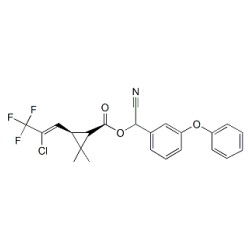 | 67291091465-08-6 | 1×100 mg | Please log in | |
ISO 17034 Certified Reference Material lambda-CyhalothrinConcentration: 100 µg/ml Solvent: Ethyl acetate | 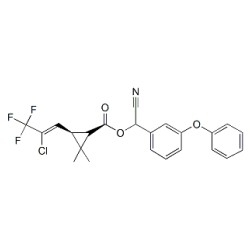 | 67351891465-08-6 | 1×5 ml | Please log in | |
ISO 17034 Reference Material D5-Cyhalothrin | 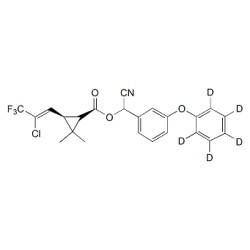 | 676154 | 1×5 mg | on request | |
ISO 17034 Certified Reference Material D5-CyhalothrinConcentration: 100 µg/ml Solvent: Ethyl acetate | 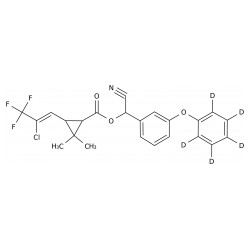 | 676155 | 1×1 ml | Please log in | |
| gamma-Cyhalothrin | 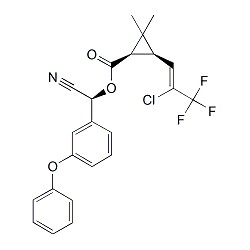 | 67691376703-62-3 | 1×100 mg | Please log in | |
ISO 17034 Certified Reference Material gamma-CyhalothrinConcentration: 100 µg/ml Solvent: Acetone | 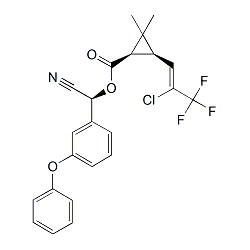 | 67768876703-62-3 | 1×1 ml | Please log in | |
ISO 17034 Certified Reference Material lambda-CyhalothrinConcentration: 100 µg/ml Solvent: Acetonitrile | 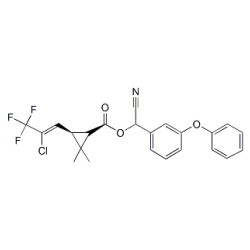 | 67837491465-08-6 | 1×5 ml | Please log in | |
ISO 17034 Certified Reference Material CyhalothrinConcentration: 100 µg/ml Solvent: Acetonitrile | 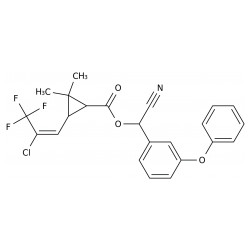 | 68507068085-85-8 | 1×5 ml | Please log in | |
ISO 17034 Certified Reference Material lambda-CyhalothrinConcentration: 100 µg/ml Solvent: Acetone | 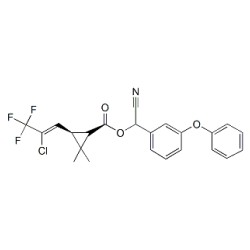 | 68884591465-08-6 | 1×5 ml | Please log in | |
ISO 17034 Certified Reference Material lambda-Cyhalothrin | 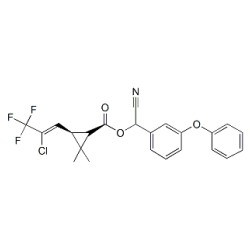 | 69231291465-08-6 | 1×50 mg | Please log in | |
Cyhalothrin
High-purity reference materials for accurate residue analysis
Overview
Cyhalothrin is a synthetic pyrethroid used as an insecticide. It is available in two main isomeric forms: lambda-cyhalothrin and gamma-cyhalothrin. These compounds are used to control a wide range of pests in agricultural and non-agricultural settings.
Uses
Cyhalothrin is primarily used in agriculture to control pests on crops such as cotton, cereals, potatoes, and vegetables. It is also used in public health for mosquito control and in termite control around building foundations.
Regulatory
In the United States, cyhalothrin is regulated by the Environmental Protection Agency (EPA) under the Federal Insecticide, Fungicide, and Rodenticide Act (FIFRA) and the Food Quality Protection Act (FQPA). In the European Union, it must be approved by the European Food Safety Authority before it can be marketed.
Monitoring
Monitoring programs ensure that pesticide residues in food are below the limits set by regulatory authorities. The Codex Alimentarius database lists the maximum residue limits for cyhalothrin isomers in various food products.
Health Impact
Cyhalothrin can be absorbed into the body by inhalation, ingestion, or skin contact. Symptoms of poisoning include burning sensation, convulsions, cough, labored breathing, and shortness of breath. It is classified as a restricted-use pesticide in the USA.
Environmental Impact
Cyhalothrin is highly toxic to fish and aquatic invertebrates but binds to soil and sediment, reducing exposure. It is also toxic to honeybees, and precautions are recommended to minimize exposure during pollinating hours.
Safety Measure
First aid measures are included with the label information. Users must follow the label instructions to minimize risks to human health and the environment. The World Health Organization (WHO) has set an acceptable daily intake for lambda-cyhalothrin.
Analytical Standards
HPC Standards GmbH provides high-purity reference materials for cyhalothrin, ensuring accurate and reliable residue analysis. Our products meet international quality requirements and the highest industrial standards, essential for laboratories conducting food and environmental analysis to ensure compliance with regulatory limits.